
What dancing does to you that the treadmill doesn't
Dancing keeps your body in shape. What far fewer people talk about is what it's doing to your mind while you're busy counting.
Most people arrive at dance through the body. Half the world dances to lose weight, and it works. An hour of Bhangra will do more for you than an hour of most things at the gym. That part isn't in dispute and I'm not going to spend an article defending it.
But ask anyone who has kept dancing for years why they keep going and nobody says the calorie count. They say something vaguer and more true: that they feel better afterwards. Lighter in a way that isn't about weight. The joy isn't a bonus attached to the exercise. The joy is the experience, and the fitness happens on the side while you're not looking.
I've been dancing since I was a child, in living rooms and studios and at other people's weddings, and it never once occurred to me to measure it. I check my watch after a run. I check after the gym. I have opened that app in the parking lot before I've put my seatbelt on. But I didn't audit dance the way I audit other life activities, and for years I assumed that was just sentimentality. I love it, so I don't hold it to account.
I think the real reason is more interesting. Whatever dance is doing, most of it is happening somewhere the fitness tracker isn't looking.
The study people keep half-remembering
There's a piece of research that circulates in dance circles in a slightly mangled form. You've probably seen the version: dancing is the only exercise that prevents dementia. That's an overstatement, and it does the actual finding a disservice, because the actual finding is strange enough on its own.
In 2003, a team at Albert Einstein College of Medicine published a study in the New England Journal of Medicine. It followed 469 people over the age of 75 for years, tracking what they did with their spare time and who went on to develop dementia. Reading, playing board games, playing a musical instrument and dancing were all associated with a lower risk. General physical activity — the walking, the swimming, the exercise most doctors recommend — showed no significant association at all.
Dancing was the only physical activity in the list that behaved like the mental ones.
This is a single observational study on a small group of quite old adults, and it cannot tell you that dancing caused anything. People who dance at 78 may simply be different from people who don't in a dozen ways nobody measured. A dance teacher promising you it prevents Alzheimer's is selling something. But the shape of the result has stuck with me for years, because it lines up with something anyone who teaches will tell you for free.
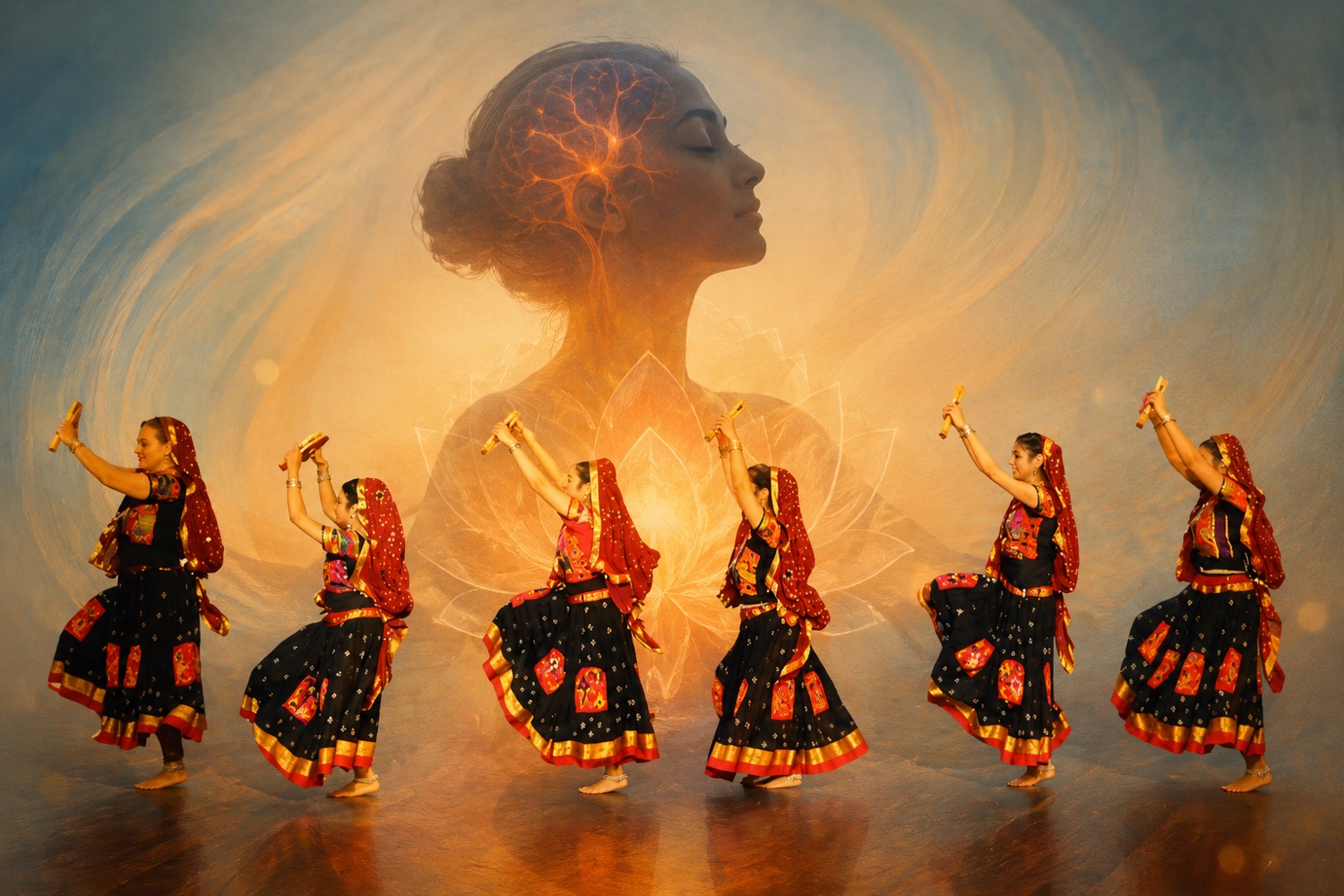
Dance isn't filed in your body. It's filed in your head, and your body is where it comes out.
Everything you're doing above the neck
Think about what is actually happening in the forty seconds it takes to learn eight counts. You're holding a sequence in working memory. You're mapping what you see in a mirror onto a body you can't see, which means reversing it, which is harder than it sounds and never stops being harder. You're tracking the music underneath all of it, so the movement has to arrive at a particular moment and not a moment near it. You're watching the person in front of you and adjusting. You're aware of the four people around you and not hitting any of them.
A treadmill asks you for none of this. That's the point of a treadmill. It's designed to be survivable while your attention is somewhere else, which is why we watch things while we're on one. Dance is the opposite. It fully occupies you. You cannot think about a difficult email while learning a turn, and if you try, you will fall out of the turn.
That's the mechanism, I think, behind both halves of it. Dance stops feeling like effort because your attention is fully spoken for, and it may do something to your mind that the treadmill doesn't for exactly the same reason.
The part nobody puts in the study
There is also something that doesn't show up in any of this research, and I'd argue it does at least as much work.
Almost every other form of exercise has been quietly redesigned so you can do it alone. You can run alone. You can lift alone. You can follow a workout on a screen in your living room and never say a word to anyone. Dance has resisted that, mostly. Even in a class of strangers you are in a room, in rows, learning the same thing at the same time. There is a particular feeling when a group of people who don't know each other hit the same count together. I don't have a study for that one. I just know I've never felt it on a treadmill.
And there's the being-bad-at-it part, which I've come to think is underrated. Most adults arrange their lives so they are rarely visibly incompetent at anything. Dance class is one of the last places a grown adult will stand in front of a mirror, get it wrong, and try again with other people watching. That's uncomfortable in a way that turns out to be good for you. It's also, incidentally, why so many people quit in week two.
What I'd actually tell you
I'm not going to claim dance will fix your back or your memory or your mood. The honest version is smaller and more useful: it's the only exercise I know of that a large number of people keep doing for decades without discipline, because they aren't enduring it. They're going to the thing they like on a Tuesday.
Whatever exercise you'll still be doing in ten years is worth more than the optimal one you'll quit in March. For a lot of people that turns out to be dance, and I don't think that's an accident.
If it's been a while, the barrier isn't fitness. It's the first forty minutes of feeling clumsy in a room full of people who look like they know what they're doing. Most of them started exactly where you're standing, and about a third of them are also counting under their breath.
The study referenced is Verghese et al., “Leisure Activities and the Risk of Dementia in the Elderly,” New England Journal of Medicine, June 2003. It's observational, and it can't establish cause. I'd rather say that plainly than round it up into a headline.
If you teach this stuff
I'm building a tool that turns one clip of your choreography into a lesson that teaches itself, and I'm looking for a small group of teachers to shape it. Free, early, no strings.
Join the Founding Guru Circle →